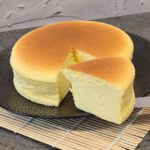
Japanese Cheesecake
This Japanese cheesecake is soft, airy, and lightly sweet with a delicate soufflé-like texture. It’s the kind of cake that feels rich and fluffy at the same time, with a golden top and a melt-in-your-mouth crumb.
Servings: 12 slices
Calories: 63kcal
Equipment
- 1 baking pan 6 inches
Ingredients
- 70 gr cream cheese
- 32 gr milk
- 16 gr butter
- 20 gr cake flour
- 6 gr cornstarch
- 2 eggs
- 1 gr salt
- 37 gr powdered sugar
- 1 tbsp lime juice
- ½ tsp vanilla extract
Instructions
- Place the cream cheese, butter, and milk in a mixing bowl (Image 1). Set the bowl over a bain-marie (a pot of gently simmering water) and whisk gently until the cream cheese and butter are completely melted and the mixture is smooth and creamy (Image 2). Remove the bowl from the heat and set aside.
- Separate the egg yolks from the egg whites (Image 3). Add the egg yolks to the warm cream cheese mixture (Image 4).
- Whisk the egg yolks into the cream cheese mixture until smooth and evenly combined (Image 5). Sift in the cake flour and cornstarch (Image 6), then whisk gently until there are no visible lumps (Image 7). Add the vanilla extract and salt and mix until combined (Image 8).
- In a clean mixing bowl, beat the egg whites until foamy (Image 9). Gradually add the powdered sugar in three additions, continuing to beat after each addition (Image 10). Add the lime juice (Image 11) and continue whipping until the meringue forms soft peaks (Image 12).
- The soft-peak stage is important—the meringue should hold its shape but the tip should gently curl over rather than stand completely stiff.
- Add about one-third of the meringue to the cream cheese batter (Image 13) and gently fold it in to lighten the mixture. Add the remaining meringue in portions, folding gently after each addition until the batter is smooth and evenly combined (Image 14). Avoid overmixing so you don't deflate the meringue.
- Pour the batter into a parchment-lined baking pan. Wrap the outside bottom and sides of the pan securely with aluminum foil to prevent water from seeping in (Image 15).
- Place the cake pan inside a larger baking pan and pour hot water into the larger pan to create a water bath. Bake in a preheated oven at 302°F (150°C) for 55 minutes. Increase the oven temperature to 356°F (180°C) and bake for another 10 minutes, until the top is golden brown.
- Remove the cheesecake from the oven and carefully take it out of the water bath. Remove it from the pan, gently peel away the parchment paper, and allow it to cool before slicing and serving.
Notes
- Use softened cream cheese – This helps it melt more smoothly with the butter and milk, so you get a lump-free batter.
- Keep the bain-marie gentle – The water should be hot but not aggressively boiling. Too much heat can make the cream cheese mixture too hot or cause it to separate.
- Let the cream cheese mixture cool slightly before adding the egg yolks – It should still be warm, but not hot enough to cook the yolks.
- Sift the cake flour and cornstarch – This keeps the batter smooth and helps prevent flour lumps in the finished cheesecake.
- Use a clean, grease-free bowl for the egg whites – Even a little yolk or grease can make the meringue harder to whip properly.
- Add the powdered sugar gradually – Adding it in three portions helps the meringue become smoother and more stable.
- Stop at soft peaks – For Japanese soufflé cheesecake, the meringue should be soft and glossy with a tip that bends over. Stiff peaks can make the batter harder to fold and may contribute to cracking.
- Fold, don’t stir – After adding the meringue, use gentle folding motions to keep as much air in the batter as possible. This is what gives the cake its light, fluffy texture.
- Wrap the pan well with foil – Since the cheesecake is baked in a water bath, make sure the bottom and sides are tightly covered so water does not seep into the cake.
- Use hot water for the water bath – This helps the cheesecake bake gently and evenly, which is important for its soft texture.
- Don’t rush the final browning – The last few minutes at the higher temperature are only to give the top its golden color, so keep an eye on it to prevent over-browning.
- Cool before slicing – The cheesecake is very delicate when hot. Letting it cool first helps the texture settle and makes cleaner slices.
Nutrition
Serving: 1slice | Calories: 63kcal | Carbohydrates: 5g | Protein: 2g | Fat: 4g | Saturated Fat: 2g | Polyunsaturated Fat: 0.3g | Monounsaturated Fat: 1g | Trans Fat: 0.05g | Cholesterol: 36mg | Sodium: 71mg | Potassium: 26mg | Fiber: 0.05g | Sugar: 3g | Vitamin A: 156IU | Vitamin C: 0.4mg | Calcium: 14mg | Iron: 0.2mg