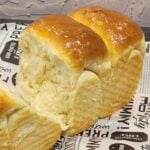
Shokupan (Japanese Milk Bread)
Soft and fluffy shokupan, also known as Japanese milk bread made with tangzhong method creating tender, pillowy crumb that pulls apart into delicate strands.
Servings: 9 slices
Calories: 188kcal
Equipment
- 1 loaf pan
Ingredients
Tang Zhong
- 20 g bread flour
- 100 g milk
Bread Dough
- 300 g bread flour
- 40 g sugar
- 4 g instant yeast
- 10 g milk powder
- 135 g milk
- 25 g butter unsalted
- 3 g salt
Instructions
Prepare the Tangzhong
- In a small saucepan, whisk together the bread flour and milk until smooth. Cook over medium-low heat, stirring continuously, until the mixture thickens into a smooth paste. Transfer the tangzhong to a bowl and let it cool completely.
Prepare and Knead the Dough
- In a stand mixer bowl, sift together the bread flour and milk powder. Add the sugar, instant yeast, egg, and milk.
- Using the dough hook attachment, start mixing the ingredients and add the cooled tangzhong. Once the ingredients are combined, add the butter and salt.
- Continue kneading until the dough becomes smooth and elastic. Shape it into a ball and place it in a lightly greased bowl. Cover with plastic wrap and let it rise for about 1 hour, or until doubled in size.
- Once the dough has doubled in size, gently punch it down to release the air. Divide the dough into three equal portions. Shape each portion into a ball, cover, and let them rest for 10 minutes to relax the gluten.
- Using a rolling pin, roll each portion into a long rectangle. Fold the two long sides toward the center, then gently roll the dough into a log, starting from one short end. Pinch the seam to seal it.
- Place the three shaped dough rolls into a greased 20 × 10 cm (8 × 4-inch) loaf pan, seam-side down. Cover loosely with plastic wrap and let the dough rise until it reaches approximately the top of the pan.
- Bake in a preheated oven at 180°C (356°F) for about 20 minutes, or until the top is beautifully golden brown and the bread is baked through.
- Remove from the oven and brush the top with melted butter for a soft, shiny crust. Transfer the bread to a wire rack and let it cool before slicing.
Notes
- Don't overcook the tangzhong. Cook over medium-low heat, stirring continuously, until it becomes a thick, smooth paste. Let it cool completely before adding it to the dough.
- Knead until smooth and elastic. Proper kneading helps develop the gluten needed for that soft, fluffy texture and beautiful pull-apart strands.
- Use softened butter. Add the butter after the ingredients are combined. Softened butter incorporates more easily into the dough.
- Let the dough double in size. During the first rise, cover the dough and let it rise until doubled. The time may vary depending on your room temperature.
- Don't skip the resting time. After dividing the dough into three portions, let them rest for 10 minutes. This relaxes the gluten and makes shaping much easier.
- Roll the dough snugly. Fold both long sides toward the center, then roll the dough into a log. Pinch the seam to seal it and place it seam-side down in the loaf pan.
- Watch the second rise. Let the shaped dough rise until it reaches approximately the top of the pan before baking. Avoid overproofing, which can cause the loaf to collapse.
Nutrition
Serving: 1slice | Calories: 188kcal | Carbohydrates: 32g | Protein: 6g | Fat: 4g | Saturated Fat: 2g | Polyunsaturated Fat: 0.4g | Monounsaturated Fat: 1g | Trans Fat: 0.1g | Cholesterol: 10mg | Sodium: 162mg | Potassium: 95mg | Fiber: 1g | Sugar: 6g | Vitamin A: 123IU | Vitamin C: 0.1mg | Calcium: 49mg | Iron: 0.3mg